

Table of Contents ▾
Pelvic floor massage is a direct and practical way to work with the muscles at the base of your pelvis. When these muscles stop working properly, you may feel burning or tightness during penetration, pressure that doesn’t ease with rest, difficulty emptying your bladder, or a sense that your body is holding tension you can’t quite reach.
This massage technique allows you to work with those deeper layers using slow, sustained pressure to release muscle gripping and improve how the pelvic floor responds. In some cases, it’s the only method that reaches tissue patterns other approaches miss.
Pelvic floor massage is helpful when symptoms appear but it can also be done preventatively, to build awareness and keep the tissues responsive and functional over time. Some women begin this work after childbirth and others simply because they’re ready to reconnect with a part of their body they have not paid much conscious attention to.
What the Pelvic Floor Consists Of
The pelvic floor is a muscular basin shaped like a curved hammock that spans the base of your pelvis and holds together four major regions of your body. The lower spine, the hips, the deep core, and the pelvic organs. It extends from the pubic bone in front to the tailbone in back and stretches laterally between the sitting bones, forming a diamond-shaped floor with layered muscular depth. These muscles are organized into four key structures:
-
The superficial layer that supports external arousal and closure reflexes.
-
The deep muscular sling (primarily the levator ani group) responsible for lift, responsiveness, and organ suspension.
-
The pelvic fascia, which connects the musculature to the abdominal wall, hips, spine, and diaphragm.
-
The neurovascular matrix, which includes an intricate web of nerves and blood vessels that regulate tone, arousal, and sensation.
Benefits of Pelvic Floor Massage

-
Circulation returns to forgotten areas: Massage brings blood flow back to spots that often go cold or numb, especially the vaginal opening, sidewalls, and perineal body.
-
Tension at the entrance softens: The tight ring of muscles around the vaginal opening, like the bulbospongiosus, often feels rigid or “closed.” With massage, that gripping sensation lets go.
-
Scar tissue becomes movable: Old episiotomy scars or labial tears often feel stuck or sting during movement or sex. With slow, steady pressure, the collagen in those scars starts to reorganize.
-
Deep pelvic trigger points release: Hard-to-reach muscles like the levator ani and coccygeus can hold tension that radiates into the tailbone, hips, or thighs. Massage helps them release, stopping those sharp,shooting pain patterns.
-
Breath and core begin to sync: A healthy pelvic floor rises and falls with your breath. After massage, that rhythm often returns: your inhale gently presses the pelvic floor downward, and your exhale lifts it back up.
-
You restore core structural strength: The pelvic sling, especially the iliococcygeus and puborectalis, regains its ability to bear load. This reduces the risk of prolapse, especially if you’ve had vaginal births or do high-impact exercise.
-
Tissue stays moist and elastic with age: Estrogen-sensitive zones like the vaginal opening and inner labia tend to dry out over time. Improved circulation and fascial mobility from massage help those tissues stay supple, reducing friction and discomfort during perimenopause and beyond.
-
Stored trauma starts to move: Even if you’ve done talk therapy or breathwork, some protective patterns stay buried in the muscle. Pelvic massage reaches the places where grief or fear are held physically.
Pelvic Floor Muscles Massage Techniques
Releasing Surrounding Structures Before Going Inward
These steps release the outer layers that influence the pelvic floor, the abdomen, groin, hips, and sacrum. You do this first to loosen the body’s grip on the pelvic bowl.
-
Lie on your back with your knees bent and feet flat. Place a folded towel under your hips if it helps your pelvis drop and relax.
-
Use both hands to massage your lower belly, starting above your pubic bone. Press in small, slow circles downward toward your pubic hairline. This helps release the abdominal fascia connected to your pelvic wall.
-
Follow the line where your thighs meet your pelvis (inguinal crease). Use your thumbs to gently press along this crease, especially near the hip bones. This releases hip flexors that tighten in response to stress and trauma.
-
Massage the inner thighs, gliding both hands upward from knee to groin. This softens the adductors, key muscles that link directly into the pelvic floor's inner anchoring points.
-
Reach behind and press into the base of your spine (sacrum) using a fist or knuckles. Make wide, slow circles from the top of your glutes down to the tailbone. You’re releasing the sacral nerves that feed directly into your pelvic floor.
Internal Techniques:
These steps target the internal muscular ring system of the pelvic floor: pubococcygeus, iliococcygeus, obturator internus. You’ll use your finger, a crystal or a Cervix wand.
These steps describe a form of yoni massage:
-
Wash your hands or sanitize your wand. Apply a body-safe lubricant. Sit in a supported squat, lie back with knees bent, or prop yourself up with pillows, your hips should feel soft and safe.
-
Place a finger or the wand just inside the vaginal opening, about 1 - 2 cm. Pause. Breathe. Don’t go deeper yet. This is where the first layer of pelvic muscles live.
-
Use the vaginal “clock” as your guide:
-
Press gently toward 3 o’clock (right wall), hold for 5 seconds.
-
Move to 6 o’clock (back wall, near the rectum), hold.
-
Continue to 9 o’clock (left wall), then 12 o’clock (front wall under the bladder).
Feel for tender spots, twitching, or numbness, these are signs of hypertonic or disconnected tissue.
-
-
When you find a tight spot, press and hold while breathing slowly. Do not poke or rub. Imagine your pelvic floor expanding downward with each exhale. Hold until the sensation softens (30 - 90 seconds).
-
Move 1 - 2 cm deeper and repeat the same clock face technique. This level touches deeper muscle fibers and connective tissue, including fascia that often grips around scars or emotional holding.
-
End with three slow strokes from deep to entrance. This flushes the tissue and resets the nervous system. Never rush this final step.
Advanced Integration: Deepening the Release
For more experienced users or those guided by a therapist.
-
Alternate internal and external massage - e.g., massage your sacrum for 2 minutes, then return to a tender spot inside. This increases blood flow and gives the muscles multiple release signals.
-
Add small movements during pressure holds, like gentle pelvic tilts or side-to-side rocking. This recruits deeper muscle fibers without force.
-
Use breath and sound to release tension. On exhale, hum or sigh through your mouth. This links the throat and pelvis, two diaphragms that often tense together.
Using Wands for Pelvic Floor Massage
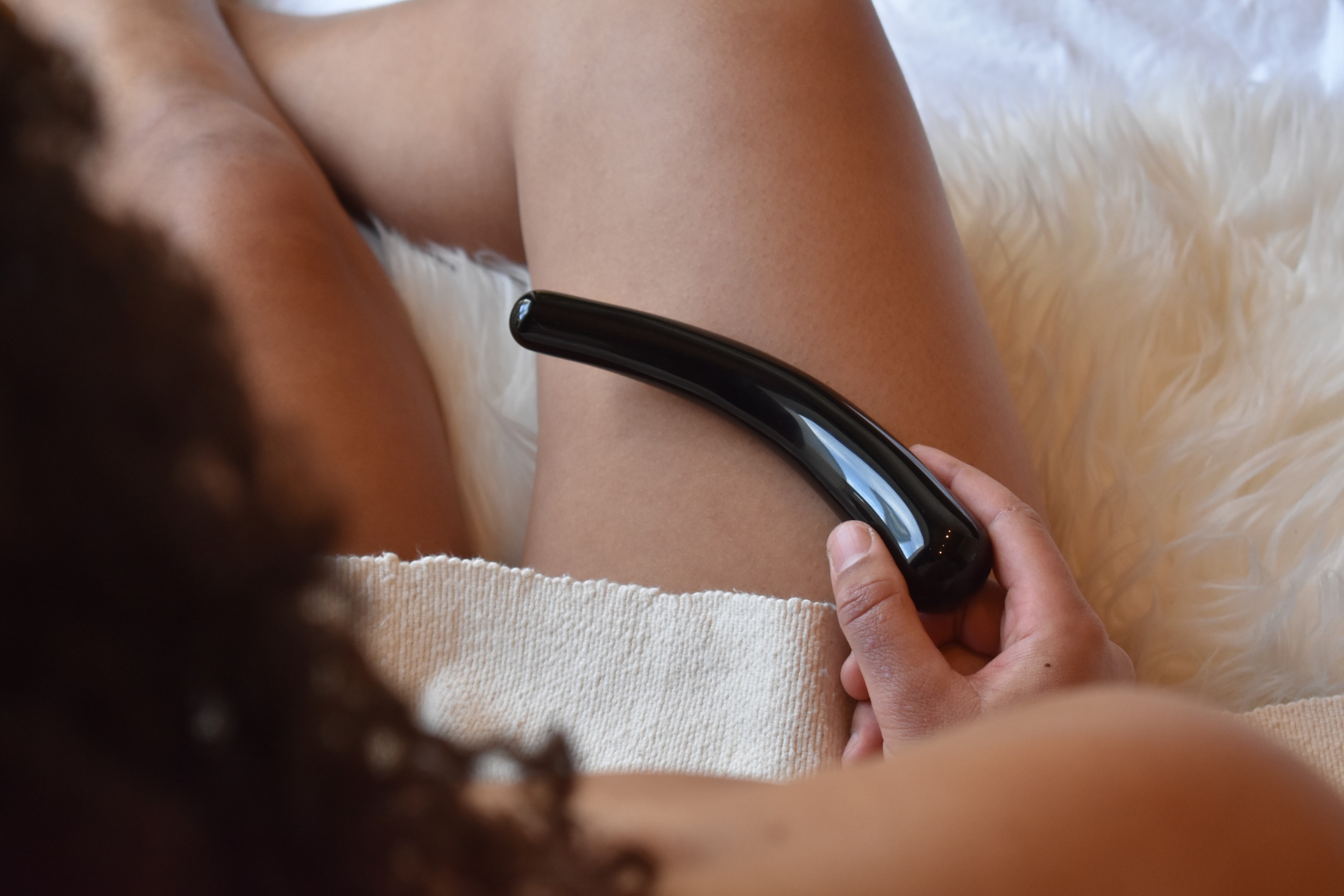
Your hands can do a lot, but they can’t reach everything. The internal pelvic floor muscles, especially those layered deep inside the vaginal canal or rectum, often hold tension that’s out of reach from external touch or surface-level breathwork. That’s where wands come in.
When it comes to pelvic floor massage, the shape of the wand you choose determines the depth and kind of release you’ll access. Each style meets the body differently, and learning how to work with these differences is part of building intimacy with your pelvic landscape.
The Straight Pleasure Wand, available in Traditional and Slim sizes, offers a simple, direct approach. Its shape allows you to gently glide the wand in and out, encouraging subtle awareness to build with each stroke. This design is especially supportive for meditative masturbation and mapping sensation throughout the vaginal or anal canal. Because it has no curve or hook, your attention stays focused on the entire length of the pelvic floor. It’s also a favorite for whole-body massage, particularly the belly and pelvic rim, where tension and emotional holding often collect.
The Curved Pleasure Wand's arc is designed to meet the g-spot, p-spot, and internal trigger points with focused pressure. The curved wand allows you to “hook into” specific areas and apply sustained contact, which is essential when working with internal knots or fascial tension. It’s also a powerful tool for de-armoring, especially for those working with tension or chronic pain during penetration. The curve allows access to angles that can’t be reached by fingers alone, making it an essential tool for deep intentional pelvic release.
The Amrita Wand™ is uniquely designed for g-spot stimulation and squirting. Its round, bulbous end naturally settles into the g-spot when angled correctly, allowing for direct and rhythmic contact that awakens this sensitive erectile tissue. What makes it stand out for pelvic floor massage is its ability to create both pleasure and release. As the internal erectile network fills with blood, lubrication increases, and the muscles around the vaginal canal begin to soften. For many women, the Amrita Wand™ helps dissolve the pattern of clenching or bracing during penetration.
The Cervix Wand™, our best-selling glass wand, is crafted from borosilicate glass, it offers a smooth, weighted glide. One end is bulbous, perfect for grounding into the cervix and applying slow, firm contact. The other is ribbed and narrow, designed for awakening sensation. What makes this wand so effective for pelvic floor massage is its dual capacity: it can meet the cervix with reverence and pressure, while also activating the g-spot and internal walls without overwhelming them.
Addressing Specific Pelvic Floor Issues
1. Pelvic Floor Tension (Hypertonic Muscles)
When you have hypertonic muscles, it means your pelvic floor muscles are stuck in “on.” They stay contracted even when you’re resting, which shortens the muscle fibers and disrupts blood flow. This tension often shows up as a burning or tearing sensation during penetration or the constant urge to pee without a full bladder.
What works:
-
Reverse Kegels are a direct interruption of your body’s impulse to grip. Instead of tightening on the exhale, you allow your pelvic floor to melt downward with your inhale. Done slowly, this breath retrains the reflex arc between your diaphragm and pelvic floor, creating a real-time shift in resting tone.
-
Internal Wand Massage meets the tension where it lives, on the inner walls of the vagina, where fingers can’t quite reach. Think of it like tracing a clock face: from 3 o’clock to 9 o’clock, moving slowly, pausing on spots that feel sharp, spongy, or blank. Holding gentle pressure for 60–90 seconds gives the muscle fibers time to lengthen and the nervous system time to stop overreacting.
-
External release of the adductor crease and perineum is essential. The pelvic floor is connected to the inner thighs, hip rotators, and fascial web that wraps the whole pelvis. Use oil and your thumbs to work along the crease where thigh meets groin. As the fascia softens, blood and lymph can return to the center. Often, the internal release follows.
2. Postpartum Recovery
After birth, the pelvic floor is changed. It may be overstretched and unresponsive, scarred and rigid, or numb from disconnection. Many women describe it as “nothing feels right down there”, because they can’t feel much at all.
What works:
-
Scar Tissue Massage should begin once cleared by a provider (typically after 6–8 weeks). Whether from perineal tears or episiotomies, scar bands behave like shoelaces tied too tight, they pull everything around them out of alignment. Using a gloved finger or crystal wand, apply sustained pressure to the scar, then gently sweep side to side.
-
Abdominal–Pelvic Breathwork re-establishes the lost connection between your breath and your pelvic bowl. Lie with one hand on your belly and one over your yoni. Inhale and visualize blood flow reaching the cervix and vaginal walls. Exhale gently and let the tissue soften under your hands.
-
Pelvic Tilts and Bridge Lifts are the re-entry point to strength. As you lie on your back, exhale and curl your tailbone slightly, lifting one vertebra at a time with quiet engagement through the iliococcygeus and puborectalis, rebuilding the muscular hammock that supports the organs above.
3. Chronic Pelvic Pain (Endometriosis, IC, or Pelvic Congestion)
Pain from conditions like endometriosis, interstitial cystitis (IC), or pelvic congestion is rarely isolated, it spreads. Nerve endings become overly responsive, sending pain signals in response to pressure, temperature, even movement that wouldn’t normally hurt. The pelvic floor muscles reflexively contract to protect the area, which increases internal pressure and reduces blood flow, trapping inflammation inside. Over time, your brain rewires itself to expect pain here. Even gentle touch, breath, or arousal can trigger a flare.
What works:
-
Internal Mapping with Breath + Wand is a non-invasive way to restore accurate sensory input. Using a smooth wand, insert slowly and “map” the canal like a clock: press gently into 1 o’clock, 2 o’clock, and so on. Breathe into each zone. Don’t try to fix anything. Just feel. Over time, the brain begins to register sensation instead of threat. This rewires the pain loop.
-
Abdominal Fascia Release targets the front of the pelvis—an area often missed in pelvic pain care. Press your fingertips into the space between the pubic bone and navel, then move side to side. The fascia here connects to the uterus, bladder, and bowel. Releasing it reduces downward drag, improves organ mobility, and soothes the pain signals that originate from visceral entrapment.
-
Sacral and Gluteal Release focuses on the piriformis and sacroiliac joints—key players in referred pelvic pain. Use a ball or your hands to apply steady pressure to the glutes, hips, and sacral notches. This relieves nerve compression and quiets pain that radiates into the pelvic floor from above or behind.
4. Pelvic Organ Prolapse
During POP, the internal organs, the bladder, uterus, or rectum. are slipping downward due to weakened pelvic support and unregulated intra-abdominal pressure. The pelvic floor is trying to hold up what it was never meant to lift on its own.
What works:
-
Inverted breathwork + gentle kegels creates upward lift without strain. Lying with legs elevated shifts he organs back into place temporarily. On your inhale, expand the ribs and let the belly soften. On the exhale, imagine the pelvic floor drawing upward, not a squeeze, but a slow rising. It’s subtle, but powerful. Over time, this pattern rebuilds functional lift where gripping used to be.
-
Yoni Egg stillness practice gives your body a chance to feel what “engaged but relaxed” actually is. Insert the egg, stand or sit in stillness, and direct awareness inward. Instead of squeezing, sense how the egg sits. Sense how your body naturally wants to rise to meet it. That’s the muscle memory we’re rebuilding.
-
Supported Squat + Sit Bone Activation places the pelvic floor in its optimal alignment. Use a bolster under your hips to enter a low, grounded squat. Rock side to side and draw your sit bones inward as if gathering energy into the bowl of your pelvis. This activates the posterior sling without increasing downward pressure. It's the antidote to straining.
FAQ
Pelvic floor massage involves applying gentle, sustained pressure to the internal pelvic floor muscles using either your index finger, a lubricated crystal wand, or a glass Cervix Wand™. The massage should follow a circular, clock-face approach inside the vaginal canal, touching the sidewalls, back wall, and front wall, while pausing on areas of tension, numbness, or tenderness.
If you’re experiencing pelvic floor dysfunction, like painful urination, vaginal tightness, or urinary or fecal incontinence, pelvic floor massage helps reduce muscle tension and improve muscle tone over time. Always use a body-safe massage oil or lubricant and work slowly, respecting your body’s response.
To release your pelvic floor at home, you need to work both internally and externally.
Start with relaxation techniques like abdominal breathing: inhale to let your pelvic floor gently expand downward, exhale without squeezing or lifting. This helps override the gripping reflex caused by chronic pelvic pain or stress incontinence.
Next, use a lubricated finger or wand to gently press inside the vaginal opening. Target tight, painful, or numb areas and hold pressure for 60–90 seconds, breathing deeply until the area begins to soften. This is called internal pelvic floor massage, and it's one of the most effective ways to reduce excessive tension and restore normal pelvic muscle function.
External massage around the pubic bone, sacrum, and adductors (inner thighs) also relieves pressure and improves overall pelvic health. This combination addresses both superficial and deep muscle layers, especially if you’re experiencing symptoms of a dysfunctional pelvic floor.
Trigger points are small knots in the pelvic floor muscles that cause referred pain, often into the hips, tailbone, or vaginal canal. They don’t respond to stretching; they respond to stillness and pressure.
To release them, insert a lubricated wand or gloved finger and press gently into the tight or tender spot. Don’t poke or rub. Hold steady pressure while breathing slowly, allowing the pelvic muscle fibers and surrounding connective tissues to release. If the spot begins to feel softer, less sharp, or warmer, the trigger point is deactivating.
You can also alternate with external massage, for example, massaging the glutes, sacrum, or inner thigh fascia, to relieve tension across the pelvic floor sling. This technique is often used in pelvic floor physical therapy but can be done at home with guidance or once you’ve been shown the proper technique by a pelvic floor specialist.
Tight pelvic muscles, also known as hypertonic pelvic floor muscles, often show up as pain during penetration, difficulty fully emptying the bladder, or stress incontinence. The first step in releasing them is breath-based down-training using techniques like reverse Kegels, where the inhale is used to lengthen and relax the pelvic floor rather than contract it.
Next, perform internal massage with a wand. Begin at the vaginal opening and move gradually deeper, using the clock-face approach to apply pressure to all areas of the pelvic floor. Focus on areas that feel sharp, resistant, or blank—these are zones where blood flow has reduced and nerve activity has
A full pelvic massage combines external massage, internal release, and breath coordination. Externally, use massage oil to work through the lower belly, pubic bone area, hip creases, and sacrum. These areas influence how the pelvic floor functions and are often overlooked in traditional bodywork.
Internally, begin just inside the vaginal opening with a lubricated finger or wand. Apply slow, sustained pressure to different points along the vaginal walls, especially the back wall (6 o’clock), sidewalls (3 and 9 o’clock), and front wall (12 o’clock), which sits just beneath the bladder and often holds tension from urinary or sexual dysfunction.
